
Wiring a solar system correctly is the difference between a safe, efficient installation and one that wastes power, trips breakers, or creates a fire hazard. Yet most solar guides show you a vague block diagram and call it a day.
This guide takes a different approach. Below you will find detailed wiring diagrams for every common solar configuration, from a single panel charging a battery to a full four-panel system powering an inverter. Each diagram includes the correct wire colors, connector types, and component placement so you can follow along with confidence. If you need step-by-step install instructions rather than diagrams, pair this guide with our DIY solar panel installation walkthrough.
Whether you are building a van life rig, wiring a cabin off the grid, or setting up a backup power system, these diagrams cover the setups you will actually use.
Solar System Components and How They Connect
Every off-grid solar system has the same core components connected in the same basic order. Understanding this chain is essential before you look at any wiring diagram.
The Solar Power Chain
- Solar Panels — Convert sunlight into DC electricity. Output voltage depends on the panel (typically 18-22V for a 12V-nominal panel) and wiring configuration.
- Solar Charge Controller — Regulates voltage and current flowing from panels to batteries. Prevents overcharging. Two types: PWM (basic) and MPPT (efficient). Check Price - Victron SmartSolar MPPT 100/30
- Battery Bank — Stores the energy for use when the sun is not shining. 12V, 24V, or 48V nominal. Check Price - Battle Born BB10012 100Ah LiFePO4
- Inverter — Converts DC battery power to AC household power (120V/240V). Only needed if you are running AC appliances. Check Price - Renogy 3000W Inverter
- Fuses and Disconnects — Safety devices on every major connection point. Non-negotiable.
- Ground Wire — Connects all metal frames and enclosures to a ground rod for lightning and fault protection.
Critical rule: Power always flows in one direction through this chain. Panels to controller to batteries to inverter. Never connect panels directly to batteries without a charge controller — you will damage the batteries and create a fire risk.
Wire Color Coding Conventions
Using the correct wire colors is not just good practice — it is a safety requirement that makes troubleshooting possible and keeps your system code-compliant. Here are the standard colors used in solar installations:
| Wire Color | Function | Where Used |
|---|---|---|
| Red | Positive (+) DC | Panel to controller, controller to battery, battery to inverter |
| Black | Negative (-) DC | Panel to controller, controller to battery, battery to inverter |
| Green | Equipment Ground | Panel frames, mounting rails, controller chassis, inverter chassis to ground rod |
| Bare Copper | Equipment Ground (alternative) | Same as green — acceptable alternative for grounding |
| Blue | Negative (-) in some DC systems | Sometimes used instead of black for negative in vehicle/marine installs |
| White | Neutral (AC side) | Inverter output to AC panel (grid-tied or sub-panel) |
Label everything. Even with correct colors, label both ends of every wire with its source and destination. A piece of tape and a marker can save hours of troubleshooting.
Connector Types: MC4, Ring Terminals, and Anderson
MC4 Connectors
MC4 (Multi-Contact 4mm) connectors are the universal standard on solar panels. Every modern panel ships with MC4 connectors pre-attached to its junction box leads.
- Weatherproof — IP67 rated, designed for permanent outdoor use
- Locking — Snap together and require a disconnect tool or firm tab press to separate
- Gender-coded — Male (pin) and female (socket) leads vary by panel maker rather than a universal convention; always verify polarity with a multimeter before connecting
- For parallel connections, use MC4 Y-branch adapters
Check Price - MC4 Connectors & Y-Branch Kit
Ring Terminals
Ring terminals are crimped onto wire ends and bolted to battery posts, bus bars, inverter lugs, and charge controller terminals. They provide a solid, vibration-resistant connection for high-current paths.
- Use copper ring terminals sized to match your wire gauge
- Crimp and heat-shrink — never solder ring terminals on high-current DC connections (solder can flow under heat and create a loose joint)
- Apply anti-oxidation compound (Noalox or similar) to prevent corrosion
Anderson PowerPole Connectors
Anderson connectors are popular for battery-to-inverter and battery-to-load connections because they are easy to disconnect by hand. Common in portable and RV systems.
- Color-coded housings (red/black) that interlock
- Available in 15A, 30A, and 45A ratings
- Not weatherproof — use indoors or in protected enclosures only
Check Price - Anderson PowerPole Connector Kit
Diagram 1: Single Panel to Battery
This is the simplest solar setup — one panel, one charge controller, one battery. Perfect for a small RV, boat, or shed.
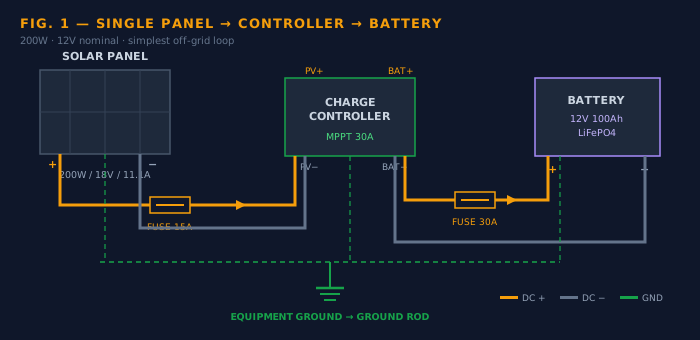
Key points for this setup:
- The charge controller must be rated for the panel's short-circuit current (Isc) with headroom — a 30A controller handles a single 200W panel easily
- Fuse the positive wire between the panel and controller, and between the controller and battery
- Use 12 AWG PV wire for runs up to 15 feet at this current level
- Ground the panel frame and controller chassis to a ground rod
Diagram 2: Two Panels in Parallel
Parallel wiring connects positive to positive and negative to negative. Voltage stays the same (18V), but current doubles (11.1A becomes 22.2A). This is the standard configuration for 12V systems with PWM controllers or shade-prone installations.
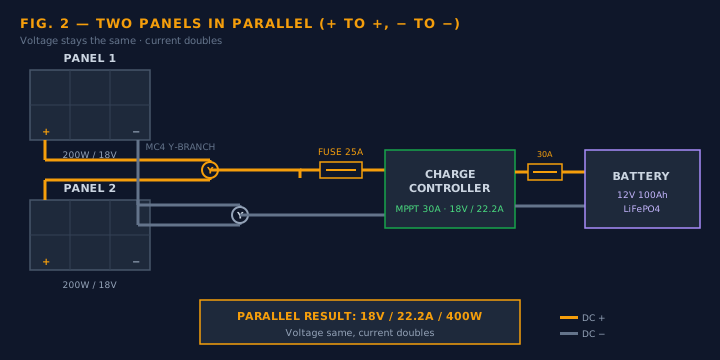
Parallel wiring notes:
- Each panel operates independently — if one panel is shaded, the other continues at full output
- The combined current (22.2A) requires heavier wire from the Y-branch to the controller (10 AWG minimum for runs over 10 feet)
- Fuse each panel's positive lead individually for systems with 3+ panels in parallel
For a deeper dive into when to choose parallel vs series, read our Series vs Parallel Wiring Guide.
Diagram 3: Two Panels in Series
Series wiring connects the positive of one panel to the negative of the next. Voltage doubles (18V becomes 36V), current stays the same (11.1A). This is the go-to configuration for 24V systems and long wire runs where you want to minimize current and wire thickness.
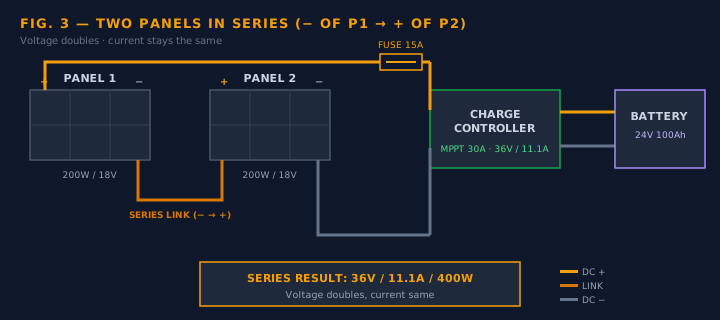
Series wiring notes:
- No Y-branch connectors needed — just plug Panel 1's negative MC4 into Panel 2's positive MC4
- Lower current (11.1A vs 22.2A in parallel) means you can use thinner wire
- The MPPT controller converts the 36V input down to your battery voltage efficiently
- Shade warning: If one panel is shaded, the entire string output drops significantly
Diagram 4: Four Panels in Series-Parallel (2S2P)
This is the most versatile configuration for medium-sized systems. You create two series strings of two panels each, then connect the strings in parallel. You get the voltage boost of series (36V) with the shade resilience of parallel (two independent strings).
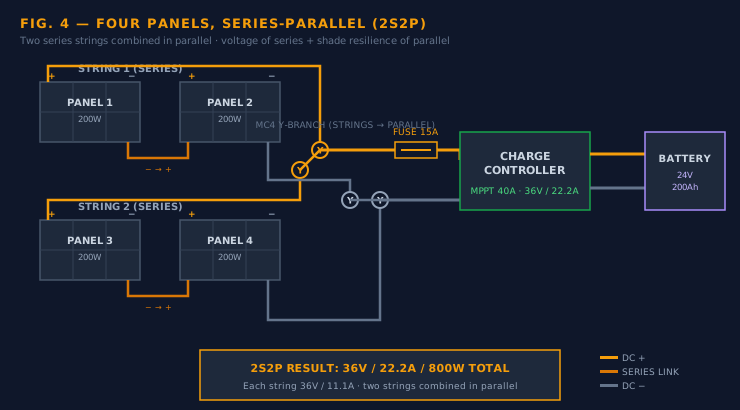
2S2P wiring notes:
- Build each series string first (Panel 1 to Panel 2, Panel 3 to Panel 4), then connect the strings in parallel using MC4 Y-branch connectors
- Both strings must have identical panels — never mix different panels within or across strings
- If one string gets shaded, the other string continues at full power
- Voc at cold temperatures: approximately 44V x 1.15 = 50.6V — well within a 100V MPPT controller's limits
Check Price - Rich Solar 40A MPPT Controller
Series vs Parallel: Complete Comparison
The four diagrams above show how to connect panels in series, parallel, and series-parallel. This section explains why you would pick each one — the exact voltage and current math, how your charge controller forces the decision, and what happens when a shadow falls across the array. If you only read one section before you start wiring, make it this one.
Every wiring choice comes down to a single trade. Wiring in series stacks voltage while current stays flat; wiring in parallel stacks current while voltage stays flat. Total wattage is identical either way — you are simply choosing the shape of the power, not the amount.
The Voltage and Current Math (4 x 100W Example)
To compare configurations you need three numbers off your panel's spec sticker:
- Vmp (Voltage at Maximum Power) — the voltage a panel produces at peak output. A typical 100W 12V panel sits around 18–20V.
- Imp (Current at Maximum Power) — the amperage at peak output. Roughly 5.5A for a 100W panel.
- Voc (Open Circuit Voltage) — the maximum voltage with nothing connected, typically 22–24V for a 100W panel. This is the number that protects your charge controller, so it matters more than Vmp for sizing.
The examples below use four identical 100W panels rated Vmp 18V, Imp 5.56A, Voc 22V. Watts equal volts times amps (W = V x A), and the total stays 400W in every configuration.
4 Panels in Series
| Spec | Per Panel | 4 in Series |
|---|---|---|
| Vmp | 18V | 72V (18 x 4) |
| Imp | 5.56A | 5.56A (unchanged) |
| Voc | 22V | 88V (22 x 4) |
| Total Power | 100W | 400W |
Voltages stack; amperage stays at single-panel level. The low 5.56A current is what makes series wiring ideal for long runs — less current means less power lost to resistance, so you can use thinner, cheaper wire over 50+ foot runs.
4 Panels in Parallel
| Spec | Per Panel | 4 in Parallel |
|---|---|---|
| Vmp | 18V | 18V (unchanged) |
| Imp | 5.56A | 22.24A (5.56 x 4) |
| Voc | 22V | 22V (unchanged) |
| Total Power | 100W | 400W |
Amperage stacks; voltage stays put. That 22+ amps is the catch: it demands thicker (more expensive) wire to avoid voltage drop and heat, and each panel's positive lead needs its own fuse once you have three or more panels in parallel to stop a failed panel from backfeeding current from its neighbors. Check Price - Inline MC4 Fuse Holders
4 Panels in Series-Parallel (2S2P)
| Spec | Per Panel | 2 in Series (per string) | 2 Strings in Parallel |
|---|---|---|---|
| Vmp | 18V | 36V | 36V |
| Imp | 5.56A | 5.56A | 11.12A |
| Voc | 22V | 44V | 44V |
| Total Power | 100W | 200W | 400W |
You get double the voltage of a single panel and double the amperage of a single string — the sweet spot for a 24V battery bank on an MPPT controller. The 36V Vmp gives the controller plenty of headroom above the 24V nominal battery, while the 11.12A combined current keeps wire sizing manageable. This is the same 2S2P layout shown in Fig. 4 above, expressed as numbers.
Matching Your Charge Controller (MPPT vs PWM)
Your charge controller dictates which wiring configuration you should use — getting this wrong is one of the most expensive mistakes in DIY solar. Pick your wiring to match the controller you own, not the other way around.
PWM Controllers Want Parallel (or Short Series)
A PWM (Pulse Width Modulation) controller essentially connects the panels straight to the battery, so the panel voltage must sit close to the battery voltage — roughly 18V for a 12V battery, roughly 36V for a 24V battery. Any voltage above what the battery needs is simply burned off as heat. Wire four panels in series (72V) into a 12V PWM controller and you waste the majority of your potential power and risk damaging the controller. Best pairing: parallel for 12V systems, a two-panel series string for 24V systems.
MPPT Controllers Want Series (or Series-Parallel)
An MPPT (Maximum Power Point Tracking) controller is a smart DC-to-DC converter that accepts a wide input-voltage range and converts excess voltage into extra charging current — typically harvesting 20–30% more energy than PWM. Higher input voltage gives the algorithm more room to optimize, and the lower panel-side current cuts wire losses. Best pairing: series or series-parallel.
The one calculation you cannot skip: every MPPT controller has a maximum input voltage (commonly 100V or 150V). Exceeding it permanently destroys the controller. Add up the Voc of every panel in a string, then add a 10–15% cold-weather margin because panels produce higher voltage in the cold. Our 4-panel series example has 88V Voc; with a 15% margin that is approximately 101V — already over the edge of a 100V controller. Drop to a 2S2P layout (44V Voc, cold-adjusted to roughly 51V) and you are comfortably within limits. This is exactly why most 4-panel arrays are wired 2S2P rather than 4S.
For a deeper controller breakdown, see our charge controller reference (MPPT vs PWM), and to choose your system voltage first, read 12V vs 24V vs 48V.
How Shading Hits Each Configuration
Shade is where the three configurations diverge most. In a series string every panel must carry the same current, so one shaded panel drags the whole string down. In parallel, each panel feeds the bus independently, so a shaded panel only loses its own share. Picture one of four 100W panels dropped to 50% output (roughly 50W):
| Configuration | Unshaded Output | With 1 Panel 50% Shaded | Loss |
|---|---|---|---|
| All Series | 400W | ~200W (entire string limited) | 50% |
| All Parallel | 400W | ~350W (only shaded panel affected) | 12.5% |
| 2S2P | 400W | ~300W (one string affected) | 25% |
Parallel wins decisively under shade; series loses the most because the shaded panel bottlenecks everything behind it; series-parallel splits the difference — only the affected string suffers. Bypass diodes built into modern panels soften the series penalty but do not erase it. If trees, a chimney, or a roofline cast moving partial shade across your array, lean toward parallel or shorter series-parallel strings — or add panel-level optimizers so each panel tracks its own maximum power point.
Check Price - Panel-Level Power Optimizers
Quick Decision Guide
Run through these five questions in order and the right configuration usually picks itself:
- What charge controller do you have? PWM almost always means parallel (12V) or a simple two-panel series (24V). MPPT gives you flexibility for series and series-parallel.
- What is your battery bank voltage? 12V systems tolerate lower panel voltages; 24V and 48V banks need series wiring to reach an adequate input voltage.
- How far are the panels from the controller? Long runs favor series — lower current means thinner, cheaper wire and less voltage drop.
- Do you have shading? Significant shade favors parallel, or series-parallel with shorter strings so fewer panels are dragged down by any single shadow.
- How many panels total? For 1–2 panels keep it simple (series for MPPT, parallel for PWM). For 4+ panels, series-parallel usually gives the best balance of efficiency, safety, and shade tolerance — and leaves room to expand by adding another parallel string later.
Diagram 5: Complete System (Panels to Controller to Battery to Inverter)
This diagram shows the full power chain from panels all the way to AC outlets. This is what a complete cabin or RV solar system looks like.
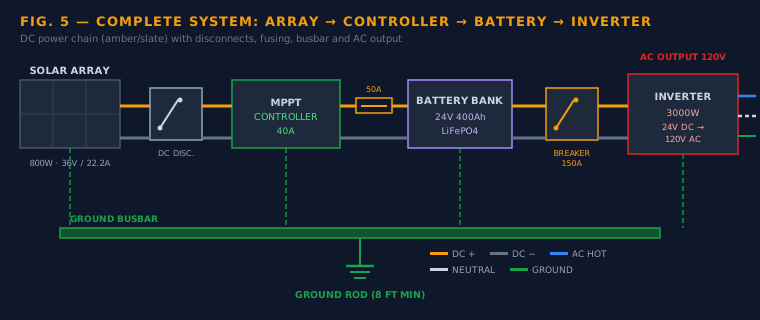
Full system notes:
- Every connection between major components should have a fuse or breaker rated for the wire and component
- The DC disconnect between panels and controller allows you to safely work on the system without disconnecting every panel individually
- The DC breaker between battery and inverter is critical — battery short circuits can deliver thousands of amps instantly
- All metal enclosures and frames connect to a common ground bus, which connects to a ground rod
Check Price - Renogy 3000W Pure Sine Inverter Check Price at Home Depot - DC Disconnect Switch
Wire Routing Best Practices
How you route your wires matters almost as much as how you size them. Poor routing leads to chafing, UV damage, rodent exposure, and code violations.
Outdoor Runs (Panel to Entry Point)
- Use PV-rated wire or USE-2 cable — these are rated for UV exposure, moisture, and temperature extremes. Standard THHN is for indoor conduit only.
- Run in conduit where possible. Schedule 40 PVC or EMT metal conduit protects wire from physical damage and rodents. Check Price at Home Depot - PVC Conduit
- Secure every 24 inches with UV-rated cable clips or conduit straps. Loose wire flapping in the wind will eventually abrade through its insulation.
- Drip loops at entry points. Before wire enters a building or enclosure, form a downward loop so water runs off the wire instead of following it inside.
- Separate DC solar wire from AC wiring. NEC requires DC and AC to be in separate conduits.
Indoor Runs (Controller to Battery to Inverter)
- Keep runs as short as possible. Every foot of wire adds resistance and power loss, especially on the battery side where current is highest.
- Use cable management trays or raceways to keep positive and negative runs organized and accessible.
- Label both ends of every wire with adhesive cable tags. Include the source, destination, and wire gauge.
- Avoid sharp bends — maintain a minimum bend radius of 6x the cable diameter.
Grounding Your Solar System
Grounding serves two purposes: it protects you from electric shock if a component develops a fault, and it gives lightning-induced surges a safe path to earth.
Equipment Grounding (Required)
Every metal component in your system must be bonded to a common ground point:
- Solar panel frames
- Mounting rails and racking
- Charge controller enclosure
- Inverter chassis
- Combiner box (if used)
- Battery enclosure (if metal)
Use 6 AWG bare copper wire or larger to bond all equipment to a ground rod driven at least 8 feet into the earth. In many jurisdictions, you need two ground rods spaced at least 6 feet apart. A common ground busbar (as shown in Fig. 5) gives every chassis and enclosure a single, inspectable landing point before the run to the rod.
Check Price - Blue Sea Systems 150A Common BusBar
System Grounding
Since NEC 2017, Article 690.41 no longer requires a solidly-grounded DC conductor — both functionally-grounded and ungrounded PV systems are permitted, and most modern charge controllers and inverters establish the functional ground internally. Do not manually bond battery negative to the equipment ground unless your controller or inverter's manual explicitly instructs it. Adding a second bond on top of the one your equipment already provides creates a dual neutral-ground bond, which can cause objectionable current on the grounding conductors. Check your equipment's manual to confirm how (and whether) it grounds the DC negative, and follow that — not a blanket rule.
Check Price at Home Depot - 8ft Copper Ground Rod
Tools and Supplies You Will Need
Here is the complete list of tools and supplies for wiring a solar system. Having everything ready before you start saves trips to the hardware store.
Essential Tools
| Tool | What It Does | Where to Get It |
|---|---|---|
| MC4 Crimp Tool | Creates weatherproof connections on solar wire | Check on Amazon |
| Wire Stripper (10-14 AWG) | Strips insulation without nicking the conductor | Check on Amazon |
| Digital Multimeter | Measures voltage, current, and continuity to verify connections | Check on Amazon |
| Torque Wrench (small) | Tightens terminal connections to manufacturer specs | Check at Home Depot |
| Cable Cutter | Clean cuts on thick gauge solar cable | Check at Home Depot |
Essential Supplies
| Supply | Specification | Where to Get It |
|---|---|---|
| PV Wire / Solar Cable | 10 AWG USE-2 rated, red and black | Check on Amazon |
| MC4 Connectors | Male and female pairs, matching your panel brand | Check on Amazon |
| MC4 Y-Branch Adapters | For parallel connections (2-to-1 or 3-to-1) | Check on Amazon |
| Ring Terminals | Copper, sized to your wire gauge and bolt size | Check at Home Depot |
| Inline Fuses / Fuse Holders | MC4-compatible for panel strings | Check on Amazon |
| Heat Shrink Tubing | Adhesive-lined, assorted sizes | Check at Home Depot |
| Cable Labels | Self-laminating wire markers | Check at Home Depot |
| Ground Wire | 6 AWG bare copper | Check at Home Depot |
Common Wiring Mistakes to Avoid
1. Connecting panels directly to batteries without a charge controller. This is the most dangerous beginner mistake. Without a controller, the battery has no overcharge protection. It will eventually overheat, swell, and can catch fire — especially lithium batteries.
2. Reversing polarity. Connecting positive to negative and vice versa can instantly destroy your charge controller. Double-check every connection with a multimeter before applying power. Read the voltage — if it shows negative, your leads are reversed.
3. Using undersized wire. The #1 cause of energy loss in DIY solar systems. Use our Solar Wire Sizing Guide to calculate the right gauge for your current and distance.
4. Skipping fuses. Every positive wire between major components needs a fuse or breaker. Battery short circuits can deliver thousands of amps — enough to melt wire and start fires in seconds.
5. Mixing MC4 connector brands. Even though they look identical, MC4-compatible connectors from different manufacturers may not seal properly. Water intrusion causes corrosion, resistance, and eventually arc faults. Stick with one brand.
6. Leaving exposed wire unprotected from physical damage. PV wire and USE-2 cable are rated for direct sun and moisture, so code permits exposed outdoor runs without conduit. Rodents and physical impact are the real risk — running vulnerable sections (near ground level, inside walls, or wherever a run could get stepped on or chewed) through conduit is recommended even where it is not strictly required. See our wire sizing guide for which runs need conduit.
7. Ignoring grounding. An ungrounded system works fine until it doesn't — a ground fault or lightning strike without a ground path can energize your entire panel frame at lethal voltage.
For step-by-step instructions on connecting your solar system to a household breaker panel, read our How to Wire Solar to Your Breaker Panel Guide.
Quick Answers: Common Wiring Questions
What gauge wire do I need for a 30A solar circuit?
For a 30-amp solar circuit, use 10 AWG copper wire for runs up to about 10 feet, and step up to 8 AWG for runs up to 20–30 feet to keep voltage drop under 3%. The exact size depends on the one-way distance and system voltage — higher-voltage (series) wiring carries less current for the same power, so it lets you use thinner wire on long runs. Always size for the circuit's continuous current plus a safety margin, and confirm against an AWG/voltage-drop chart or the Wire Size Calculator.
Should I wire my solar panels in series or parallel?
Wire in series if you run an MPPT controller, have a 24V or 48V battery bank, or have long cable runs; wire in parallel if you run a PWM controller, have a 12V system, or face frequent shading. Series stacks voltage (and keeps current low, saving wire), while parallel stacks current and keeps each panel independent so shade on one panel does not drag down the others. For 4 or more panels, a series-parallel (2S2P) layout usually balances both — see the complete comparison above.
Where do fuses go in a solar wiring diagram?
Place a fuse or breaker on the positive conductor of every connection between major components — between the panels and the charge controller, between the controller and the battery, and between the battery and the inverter. The battery-to-inverter fuse is the most critical because a battery short can deliver thousands of amps in an instant. Size each fuse just above the circuit's normal current and at or below the ampacity of the wire it protects. Every diagram on this page shows fuse placement on the amber positive paths.
Can I add more solar panels to an existing system later?
Yes, as long as your charge controller has headroom and you wire for expansion from the start. Confirm the new total stays under the controller's maximum input voltage (for series additions) and maximum input current (for parallel additions), and use identical panels in any string you extend. A system wired 2S2P can grow to 2S3P simply by adding another matched parallel string — which is why choosing a controller with spare capacity up front saves a full rewire down the road.
Frequently Asked Questions
What color wires are used in solar panel systems?
The standard color coding is red for positive DC connections, black for negative DC connections, green or bare copper for ground, and white for neutral on the AC side of inverters. Always label your wires clearly at both ends, especially in larger systems where multiple wire runs can look identical.
Can I use regular household wire for solar panels?
No. Standard indoor Romex (NM-B) wire is not rated for outdoor UV exposure or the temperature extremes solar installations face. Use PV wire (also called photovoltaic wire) or USE-2 rated cable for all outdoor runs between panels and your charge controller. These are rated for sunlight resistance, moisture, and higher temperatures.
What are MC4 connectors and do I need them?
MC4 (Multi-Contact 4mm) connectors are the industry-standard weatherproof connectors used on virtually all modern solar panels. They snap together securely and are rated for outdoor use. You need them for panel-to-panel connections and for connecting panels to your charge controller using extension cables. For parallel wiring, you will also need MC4 Y-branch adapters.
Do I need to ground my solar panel system?
Yes, equipment grounding is always required — bond panel frames, mounting rails, the charge controller enclosure, and the inverter chassis to a ground rod driven at least 8 feet into the earth, using 6 AWG or larger bare copper wire. System grounding (bonding a DC current-carrying conductor) is different: since NEC 2017, Article 690.41 no longer mandates a solidly-grounded DC conductor, so most modern controllers and inverters use a functional ground internally and no manual bond is needed. Do not add a second bond on top of what your equipment already provides unless its manual explicitly calls for it — check the manual to confirm how (and whether) it grounds the DC negative.
How many solar panels can I wire together?
The limit depends on your charge controller. For series wiring, add up the open-circuit voltage (Voc) of all panels and add a 15% cold-weather safety factor — the total must stay below your controller's maximum input voltage. For parallel wiring, add up the short-circuit current (Isc) of all panels — the total must stay below your controller's maximum input current. Most systems use 2 to 8 panels per charge controller.
What is the difference between MC4 and Anderson connectors?
MC4 connectors are the standard for panel-to-panel and panel-to-controller connections. They are weatherproof and designed for permanent outdoor installations. Anderson PowerPole connectors are popular for battery-side and indoor connections because they are easy to connect and disconnect by hand without tools. Many people use MC4 on the panel side and Anderson on the battery and inverter side.
Can I run solar wires through the same conduit as household AC wiring?
No. The NEC requires that DC solar wiring and AC household wiring be run in separate conduits or raceways. Mixing them creates safety hazards and violates electrical code. Keep your solar DC runs physically separated from any AC wiring throughout your installation.
What size wire do I need between my solar panels and charge controller?
Wire size depends on the current (amps) and the distance of the run. For a typical 200W 12V system with a 10-foot run, 12 AWG wire is adequate. For longer runs or higher-current systems, you need thicker wire (lower AWG number). Use a voltage drop calculator to keep losses under 3%. See our detailed solar wire sizing guide for complete charts.