
Concept status: Technically plausible. Individual subsystems are commercially available or field-tested. The fully integrated residential product described here is not currently available as a standard packaged system. Nothing on this page has been built, installed, or tested by Off Grid Authority — this is an engineering thought experiment grounded in real components and real thermodynamics, not a build guide, and it should be read that way.
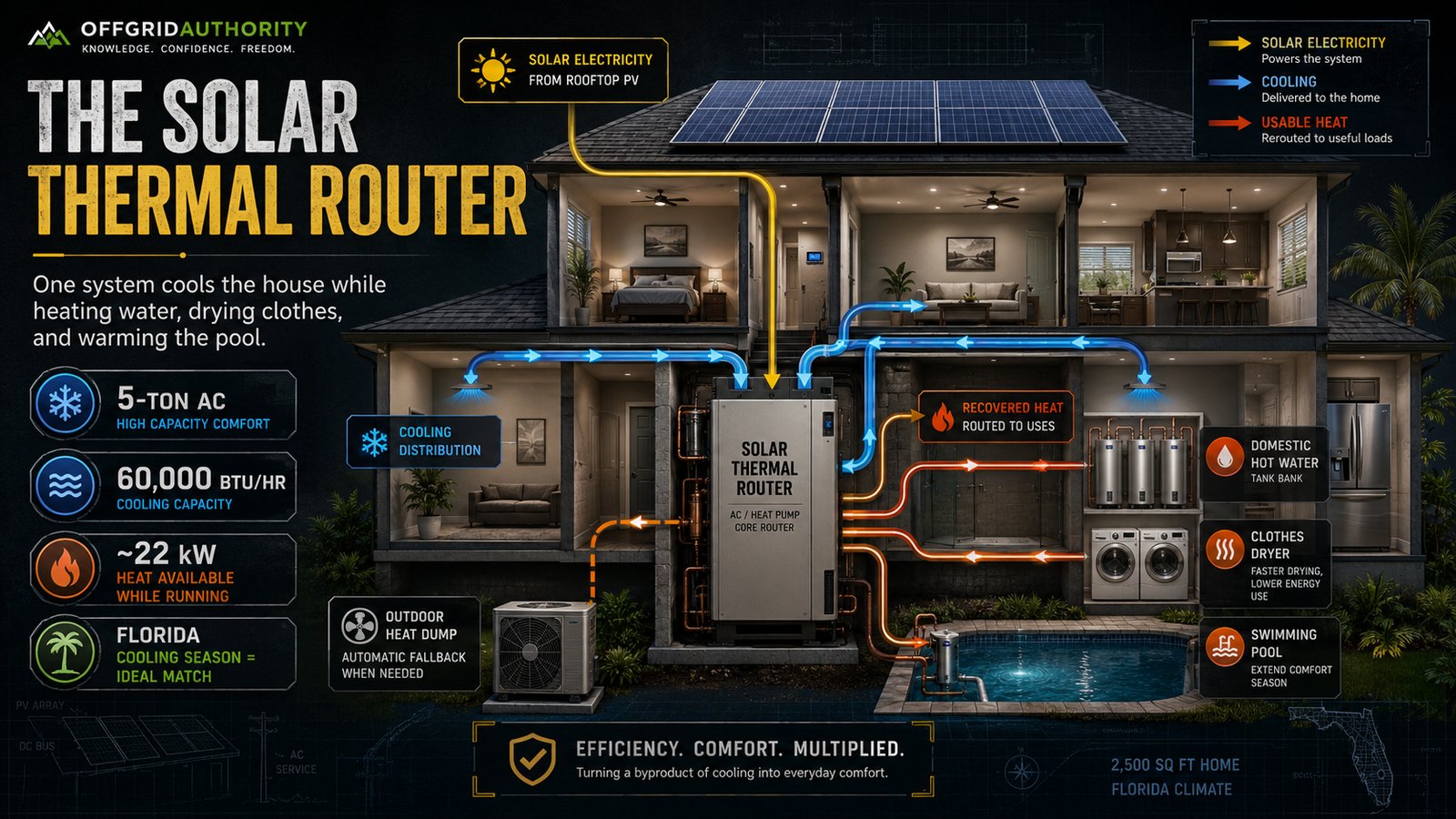
A normal house pays to move heat in opposite directions all day.
The air conditioner spends electricity pulling heat out of the house. It throws that heat outdoors. At the same time, the water heater spends electricity creating heat. The clothes dryer creates more heat. The pool heater may create an enormous amount of heat.
That is not a law of physics. It is mostly a consequence of appliances being designed as separate boxes.
A solar thermal router would treat the home as one connected energy system:
Use solar electricity to run the air conditioner, capture the heat it removes from the house, store that heat, and route it to whatever needs it next.
The system is theoretical as a complete consumer product, but nearly every major piece already exists separately: direct-solar heat pumps, air-conditioner heat-recovery water heaters, combination space-conditioning and water-heating systems, thermal storage tanks, heat-pump dryers, and pool heat-recovery systems.
The missing product is the controller and plumbing architecture that makes them operate as one machine.
The Basic Idea
A heat pump does not destroy indoor heat. It moves it.
When a five-ton air conditioner is running, it may remove about 60,000 BTU per hour from the house. The compressor also adds several kilowatts of electrical energy to the refrigerant loop. The condenser therefore has to reject roughly 77,000 to 80,000 BTU per hour, or about 22 to 23 kW of heat.
A conventional system sends all of that heat into the outdoor air. A thermal router would send it somewhere useful first — though "somewhere useful" does not mean all of it arrives for free. How much of that heat you can capture without costing yourself compressor efficiency depends entirely on where in the cycle you tap it, which is the point this whole article keeps coming back to.
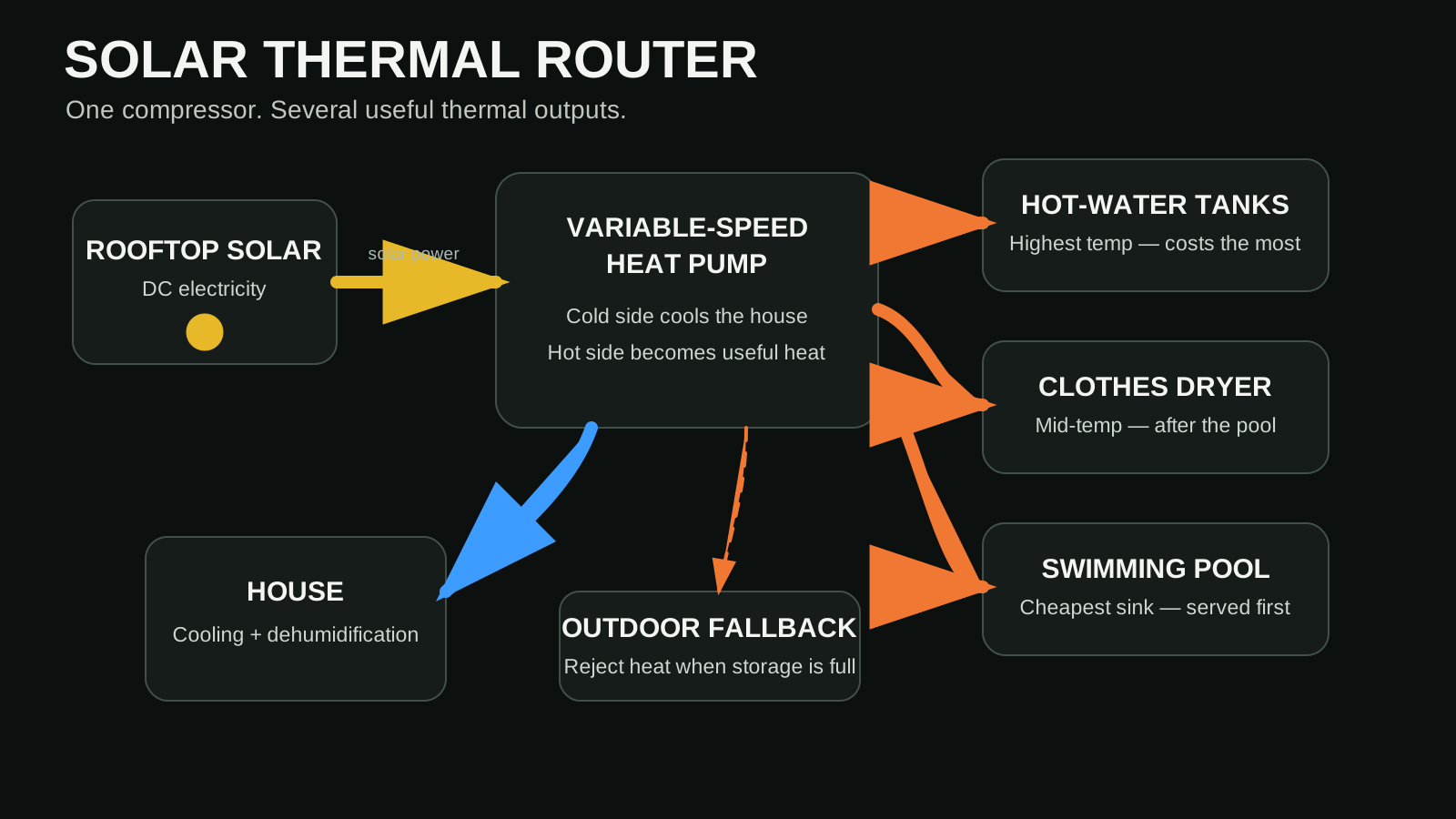
Heat-routing priority (cheapest sink first)
- Swimming pool — a near-ambient sink around 83°F, the one leg that is field-proven and can leave compressor efficiency unchanged or even improve it
- Domestic hot water preheat — a small, genuinely free slice of heat captured by a desuperheater before the refrigerant sees any efficiency cost
- Full-temperature domestic hot water and clothes drying — the expensive tier, worth doing only when there is heat to spare and the math still works after the efficiency hit
- Outdoor condenser — the fallback for whatever heat is left over
This list is ordered by what costs the least compressor efficiency, not by which use is thirstiest for temperature. That is a deliberate correction: it is tempting to route the hottest refrigerant to domestic hot water first because water heating "needs the highest temperature," but needing the highest temperature is precisely what makes a heat sink expensive, not what earns it first place in line. The pool goes first because it is the cheapest possible place to dump heat — sometimes even cheaper than the outdoor air a conventional AC already dumps into.
The air conditioner still cools the house normally. The difference is what happens to the heat after it leaves the indoor coil.
How the System Would Work
1. Solar powers the compressor directly
A variable-speed compressor can follow available solar production. Existing hybrid solar mini-splits already accept direct photovoltaic input and blend in grid electricity when solar production is insufficient — the same direct-DC principle that already works for other off-grid loads, like a solar-powered well pump that runs straight off panel output without a full inverter in between.
A whole-house version would need a larger inverter-driven compressor, likely supported by:
- A dedicated solar array
- A high-voltage DC bus
- Grid assist for clouds and nighttime operation
- Optional battery support for controls, pumps, and short interruptions
The goal is not necessarily to run the entire house from batteries. The compressor is the largest daytime load, and daytime is when solar production and cooling demand often align best.
2. The indoor coil produces cooling
The evaporator removes heat and moisture from indoor air exactly like a standard central air conditioner — the same fundamentals covered in our off-grid heating and cooling guide, which walks through why moving heat with a compressor beats making it with resistance elements.
That provides:
- Space cooling
- Dehumidification
- Optional chilled-water or phase-change storage
- Limited pre-cooling of the house during peak solar production
3. A refrigerant manifold routes the recovered heat
The hot refrigerant leaving the compressor passes through a series of controlled heat exchangers. The routing order matters more than it first looks, and the naive version of this idea — send the hottest gas to the water heater first because water heating needs the highest temperature — gets the economics backward.
The manifold should serve the pool first whenever it is calling for heat. A 15,000-gallon pool sitting near 83°F is a near-ambient sink, often cooler than a Florida afternoon's outdoor air, so diverting the condenser to pool water instead of hot outdoor air can hold condensing temperature down — or even lower it — without hurting compressor efficiency. This is arguably the centerpiece claim of the whole concept: it is the one leg of the cascade that can improve efficiency, not merely add free heat on top of unchanged efficiency, because pool water conducts heat away far better than air and is frequently the cooler of the two.
Next in line is a desuperheater tapped onto the discharge line ahead of the main condenser. It strips only the superheat off the hot gas — typically 10–15% of the total heat of rejection for a residential system — before the refrigerant reaches saturation temperature, delivering preheated water up to roughly 110–130°F with no meaningful efficiency penalty. This is the genuinely free slice of the whole system.
Only after the pool and the desuperheater preheat are satisfied should the system attempt to push the refrigerant to the higher condensing temperatures needed for full-temperature domestic hot water (120–150°F) or dryer-grade heat. That takes real work: raising condensing temperature increases compressor head pressure and can cut cooling efficiency by something on the order of 20–40%, so the controls should only take this path when there is genuinely excess heat with nowhere cheaper to send it, and the numbers still pencil out after the efficiency hit.
When all useful heat sinks are satisfied, a normal outdoor condenser rejects whatever is left.
The catch with the pool leg: it needs a pool-safe heat exchanger (titanium or cupronickel plates for chlorine or saltwater chemistry), valving that lets the compressor keep rejecting heat normally when the pool doesn't want any, code-compliant separation from any potable water loop, and enough circulation-pump capacity that the pump's own electricity draw doesn't eat the efficiency gain. None of that is exotic — commercial pool dehumidification systems already do it — but it is real engineering, not a garden hose and a plate.
4. Water tanks and the pool store the energy
Electrical batteries store electricity. This system mainly stores temperature.
That can be dramatically cheaper per unit of stored energy when the final use is heat.
How Much Heat Does a Five-Ton AC Actually Produce?
A five-ton system has a nominal cooling capacity of:
- 60,000 BTU per hour
- 17.6 kW of cooling
At a realistic full-load electrical draw of roughly 5 to 5.7 kW, the outdoor side must reject approximately:
- 22.6 to 23.3 kW of heat
- 77,000 to 79,500 BTU per hour
The simple relationship is:
Heat delivered to the hot side = heat removed from the house + compressor electricity
So while the AC is running, it can produce far more thermal power than a normal water heater or dryer heating element consumes.
| Load | Typical thermal demand while active | Could a five-ton AC cover it? |
|---|---|---|
| Electric water heater element | 4.5 kW | Yes |
| Large electric dryer heater | 4 to 5.5 kW | Yes |
| Residential pool heating | Variable | Often yes, with the pool absorbing the remainder |
| All three simultaneously | Roughly 10 to 20+ kW | Often possible at high AC output |
Important distinction: rejected heat is not the same as free heat. Every number above describes heat the condenser has to reject — thermal energy that has to go somewhere. It is not automatically free hot water and free pool heat. The desuperheater slice (roughly 10–15% of total heat of rejection) is close to free: no meaningful hit to cooling efficiency. Recovering the rest — the latent heat released as refrigerant condenses — means diverting the full condenser into a water-cooled exchanger, which raises condensing temperature and adds real compressor work. Whether that trade is worth it depends entirely on how cheap the receiving sink is, which is exactly why the pool, not the water heater, is the sink worth chasing first.
The important limitation is not instantaneous power. It is matching supply and demand across the day and year.
The Pool Is the Giant Thermal Battery
Water stores a large amount of heat cheaply.
Hot-water tank storage
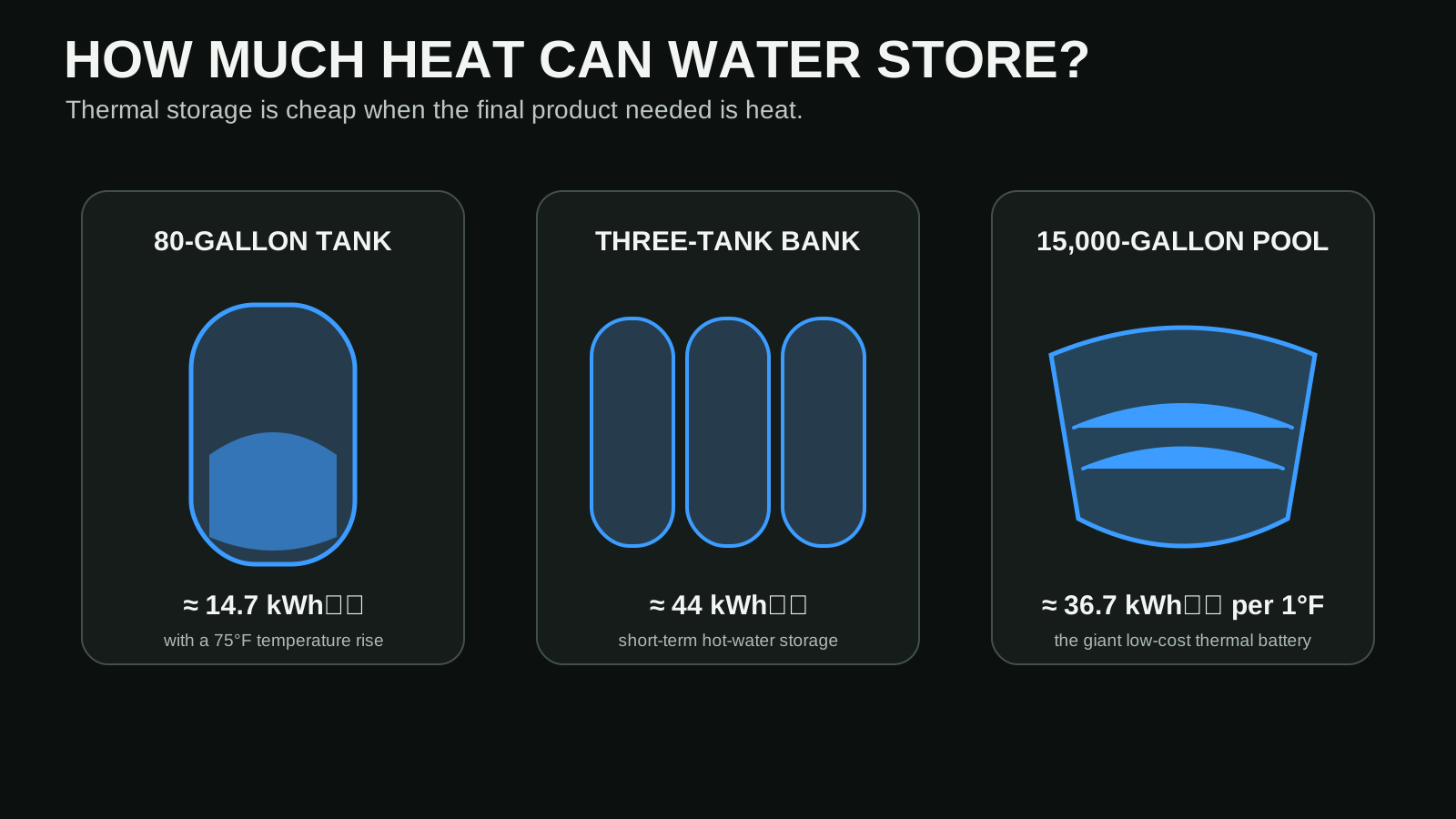
An 80-gallon tank heated through a 75°F temperature rise stores about:
- 50,000 BTU
- 14.7 kWh of thermal energy
Three 80-gallon tanks would store about:
- 44 kWh of thermal energy
That is enough to absorb approximately two hours of the full recovered heat from a five-ton AC.
A mixing valve could allow the tanks to store water hotter than the normal delivery temperature while still supplying safe-temperature water to fixtures.
Hot-Water Tank Storage Hardware
Bigger, better-insulated preheat storage is the cheapest upgrade in this entire concept — it buys time between when the compressor makes heat and when someone actually wants it.
Pool storage
A 15,000-gallon pool stores approximately:
- 36.7 kWh of heat for every 1°F temperature increase
A 3°F increase represents roughly:
- 110 kWh of thermal storage
The pool is therefore not just a heating load. It is a huge, inexpensive heat sink that can stabilize the entire system — and, as the refrigerant-manifold section above argues, it is also the one part of this concept with the best field evidence and the cleanest physics: a pool that runs cooler than a Florida afternoon's outdoor air is a better place for a condenser to dump heat than the sky is, not just a bigger one.
Pool Heat-Recovery Hardware
A pool cover may deserve the strongest recommendation of anything in this article — preventing evaporation is often more economical than adding more heat, and it works whether or not you ever build a thermal router.
Would the AC Produce Enough Heat for Everything?
For many warm-climate homes, yes, at least during the cooling season.
Consider a 2,500-square-foot Florida house with:
- Five-ton central AC
- Standard electric-resistance water heater
- Large electric dryer
- Heated 15,000-gallon pool
- Large rooftop solar array
A five-ton AC rejecting an average of 22 kW of heat for six equivalent full-load hours would produce approximately:
- 132 kWh of thermal energy in one day
That 132 kWh figure is a theoretical ceiling, not a promise of 132 free kilowatt-hours delivered to your taps and pool. Only the desuperheater's free slice — roughly 15–20 kWh of that total, depending on runtime — arrives without an efficiency cost. Capturing more requires the full-condenser diversion described above, at a real efficiency penalty that has to be justified by a cheap-enough sink, which in practice means the pool.
If all of that ceiling could be captured and used, possible daily allocations might look like:
- Domestic hot water: 10 to 20 kWh
- Clothes drying: 3 to 6 kWh
- Raising a 15,000-gallon pool by 2°F: about 73 kWh
- Tank and piping losses: several additional kWh
The heat supply is large enough. The engineering challenge is ensuring there is somewhere useful to put it.
During extremely hot weather, the AC may produce more heat than the house can use. The system still needs an outdoor condenser.
During cool weather, the house may need hot water or pool heating while producing little or no cooling heat. The system then needs grid power, stored heat, a heat-pump mode, or another backup source.
A Realistic Daily Operating Cycle
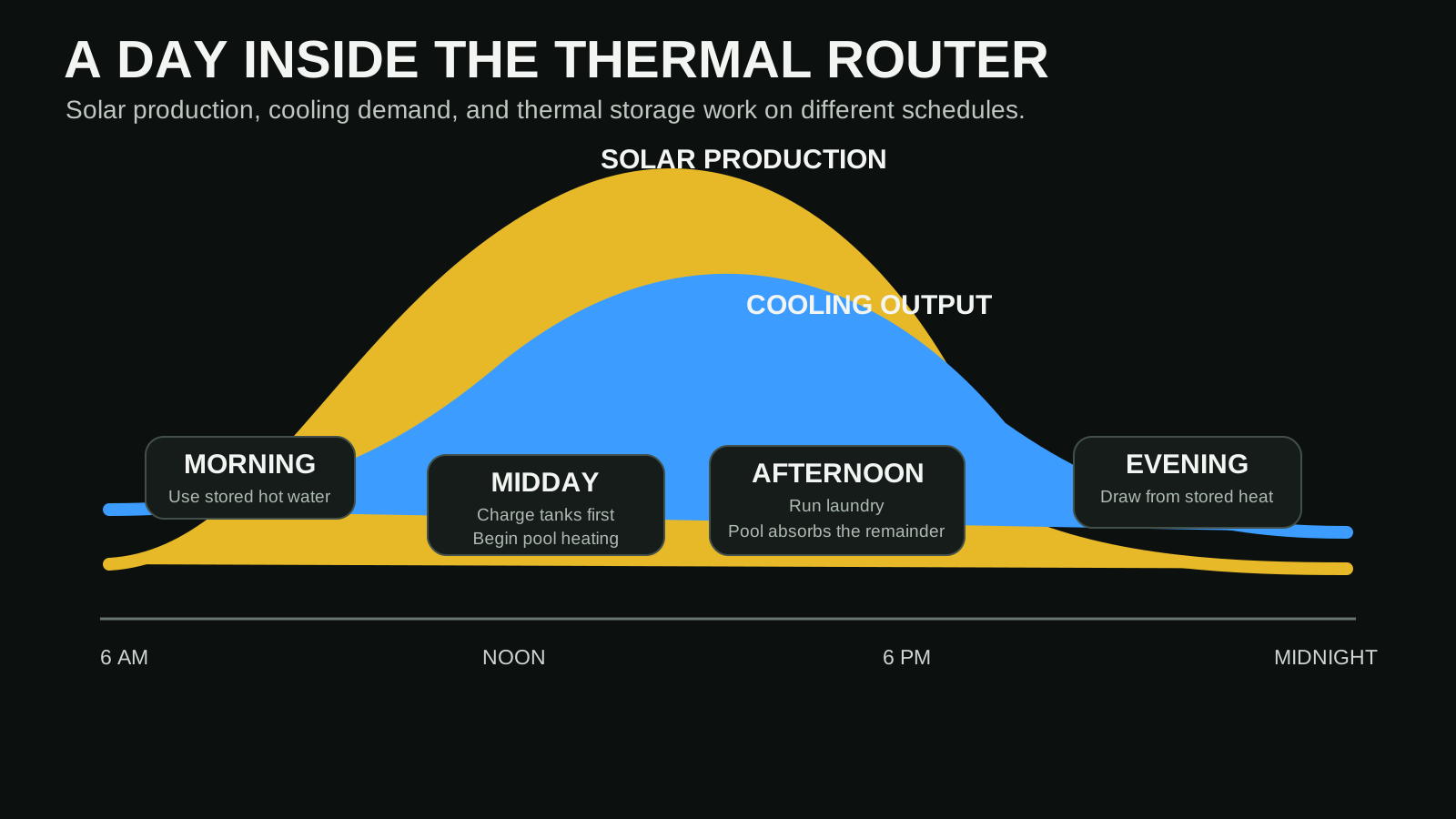
Morning
- Stored hot water supplies showers.
- The pool may be cool from overnight evaporation.
- The AC runs lightly or remains off.
- Grid or stored energy covers any unmet hot-water demand.
Midday
- Solar production rises.
- The variable-speed compressor increases output.
- The house is cooled and dehumidified.
- The pool loop opens first whenever it's calling for heat; domestic hot-water tanks pick up the desuperheater's free slice alongside it.
- Excess heat continues warming the pool.
Afternoon
- Solar and cooling demand are both high.
- The system may run near maximum output.
- Laundry can be scheduled during this period.
- Dryer heat comes from the refrigerant loop instead of a resistance element.
- The pool absorbs remaining heat.
Evening
- The house coasts on earlier cooling.
- Hot-water tanks supply showers and dishes.
- The pool slowly releases stored heat to the environment.
- The grid handles only the remaining electrical loads.
Why Not Simply Make the House Extremely Cold?
The house can provide some thermal storage, but it is not the best battery.
Aggressively overcooling creates comfort problems, condensation risk, and unnecessary heat gain from outdoors. A better strategy would be:
- Pre-cool the house by a modest amount
- Maintain humidity control
- Store additional cooling in water, ice, or a phase-change material
- Store heat in insulated water tanks and the pool
The system should optimize comfort first, not turn the house into a refrigerator.
Estimated Energy Savings
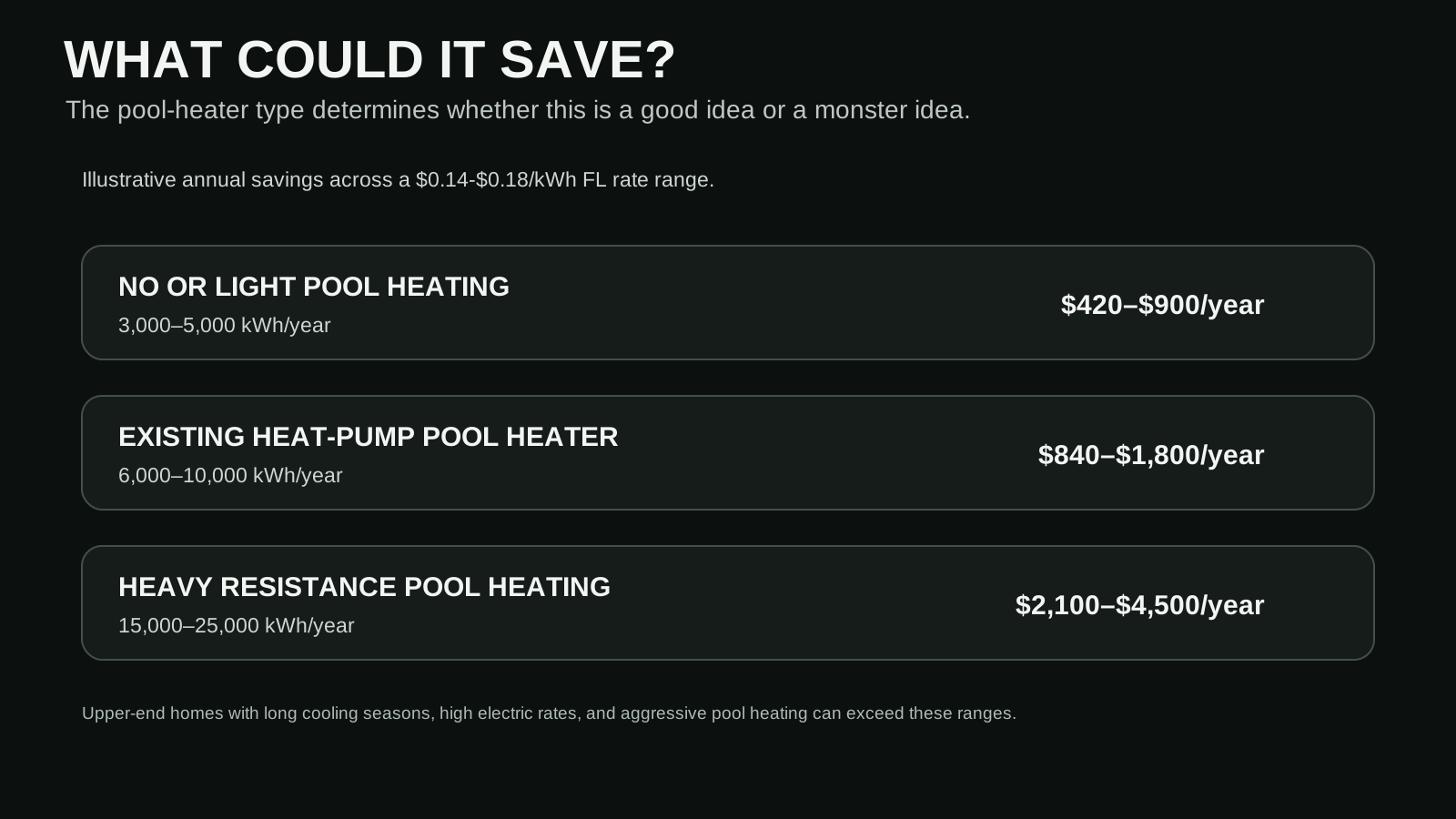
The savings depend heavily on the type and use of the pool heater. Florida residential electricity runs roughly $0.14 to $0.18 per kWh depending on utility territory and rate rider — FPL's own published rate sheet sits nearer the low end of that band, while other Florida utility territories run closer to the high end — so the scenarios below are computed across that range rather than a single flat rate.
Scenario A: No pool heating or very light pool heating
The recoverable loads are mainly domestic hot water and dryer heat.
Potential annual savings:
- Water heating: 2,500 to 4,500 kWh
- Dryer heating: 300 to 700 kWh
- Possible AC efficiency improvement: 0 to 600 kWh
- Pump and control energy: subtract 150 to 400 kWh
Illustrative net savings: 3,000 to 5,000 kWh per year
At $0.14–$0.18 per kWh:
$420 to $900 per year
Scenario B: Pool already uses a heat-pump heater
The thermal router replaces some electricity that the pool heat pump would have consumed, but the existing pool heater is already efficient.
Illustrative net savings: 6,000 to 10,000 kWh per year
At $0.14–$0.18 per kWh:
$840 to $1,800 per year
Scenario C: Heavy electric-resistance pool heating
This is the strongest economic case because every recovered unit of heat can replace approximately one unit of resistance-heating electricity.
Illustrative net savings: 15,000 to 25,000 kWh per year
At $0.14–$0.18 per kWh:
$2,100 to $4,500 per year
That equals an annualized average of roughly:
$175 to $375 per month
A very heavily heated pool, electric rates nearer the top of the range, a large family, and long AC runtime could push the value toward $400 to $500 per month, but that should be treated as an upper-end use case, not the expected result for every house.
Does Direct Solar Make the Heat Free?
Not exactly, but it can make the marginal operating cost extremely low.
The solar array and equipment still have a purchase cost. Pumps, fans, controls, and compressors still wear. Some grid electricity will still be needed.
But once the solar system exists, one flow of solar electricity can create several useful outcomes at once:
- It runs the compressor.
- The compressor cools and dehumidifies the house.
- The rejected heat heats domestic water.
- The remaining heat dries clothing.
- The final low-temperature heat warms the pool.
This does not violate energy conservation. It is using both sides of the heat-pump cycle instead of paying for the cold side and discarding the hot side.
One more honest caveat: recovered heat is time-coincident with compressor runtime, not with when someone actually wants a hot shower or a warmer pool. The AC makes its heat hardest on hot, sunny afternoons; people shower mornings and evenings, and pool heat loss happens around the clock. The hot-water tank and the pool itself are the two buffers that decouple supply from demand — without them, this concept only works during the exact hour the compressor happens to be running.
Current Solar-Powered Cooling Hardware
You cannot currently buy the complete thermal router described in this article, but direct-solar heat pumps already provide the electrical half of the system.
- Check price — JNTECH 12,000 BTU AC/DC solar hybrid mini-split (the name-brand alternative, EG4's hybrid mini-split line, sells direct from the manufacturer rather than through Amazon)
- Check price — Pioneer WYS012A variable-speed inverter heat pump
- Check price — HQST 400W monocrystalline solar panel
- Check price — MidNite Solar DC disconnect + Tigo rapid-shutdown module
Why This Product Does Not Already Dominate Florida
The physics is easier than the product.
Different industries own each appliance
Central HVAC, plumbing, laundry appliances, pools, solar, and home automation are sold and serviced by different trades.
A single integrated system crosses every boundary.
Temperature requirements are different
Domestic water may need storage temperatures around 120°F to 150°F. A dryer needs warm moving air. A pool only needs relatively low-temperature heat.
That is useful for cascading heat, but it requires multiple heat exchangers, valves, sensors, and control modes.
Higher condenser temperatures can reduce AC efficiency
The system should not force the compressor to make extremely hot water when that would erase the efficiency benefit.
The controls must decide when to:
- Heat water directly
- Use a secondary heat pump stage
- Send heat to the pool
- Reject heat outdoors
- Use backup resistance heat
Timing does not always align
People shower in the morning and evening. Solar peaks near midday. Laundry may happen at any time. Cooling demand changes with weather. Recovered heat only exists while the compressor is actually running, and hot afternoons don't always line up with hot-water or drying demand — a mild or rainy day can leave little or no heat to recover at all, no matter how the cascade is prioritized.
Thermal storage and predictive controls are what make the concept practical.
A custom one-off system would be expensive
A bespoke installation could cost more than the energy it saves. The real opportunity is a factory-built product with standardized connections, controls, diagnostics, and installer training.
Existing Technology That Proves the Pieces Work
This is not a machine built from imaginary components.
Direct-solar air conditioners
Commercial hybrid solar mini-splits already accept direct photovoltaic input and blend solar with grid electricity.
AC heat-recovery water heating
Residential heat-recovery units already connect to the hot refrigerant line of a central AC and transfer that heat into a preheat water tank.
Combination heat pumps
Researchers and manufacturers have built systems that use one outdoor heat-pump unit for space conditioning and domestic hot water.
Pool heat recovery
A field study using a rooftop AC unit rejected heat into a swimming pool, reduced pool-heater fuel use, and lowered cooling electricity consumption when the pool was a more favorable heat sink than outdoor air — the real-world evidence behind the centerpiece claim in this article. See the Sources section for the study itself.
Smart thermal batteries
Commercial systems already use large water tanks, predictive controls, and heat pumps to shift household heating loads around electricity prices and solar availability.
Direct-DC heat pumps
Recent laboratory and field research has demonstrated that residential heat pumps can be connected to DC distribution with relatively modest hardware changes, reducing repeated AC/DC conversion losses.
The complete solar thermal router is therefore an integration problem, not a request for new physics.
What a Real Product Should Include
Core equipment
- Variable-speed five-ton heat pump
- Direct PV input or high-voltage DC bus
- Grid-assist input
- Indoor air handler
- Outdoor fallback condenser
- Multi-port refrigerant routing module
Heat storage and distribution
- One or more insulated preheat tanks
- Standard finishing water heater or integrated high-temperature stage
- Pool water heat exchanger (titanium or cupronickel for chlorine/saltwater chemistry)
- Closed-loop dryer heating coil
- Mixing valve
- Variable-speed circulation pumps
Sensors
- Refrigerant temperature and pressure
- Tank temperature at multiple heights
- Pool water temperature
- Indoor temperature and humidity
- Solar production
- Grid price or demand signal
- Dryer status
- Water-use prediction
Control software
The control system should optimize for:
- Indoor comfort and humidity
- Domestic hot-water availability
- Maximum use of available solar
- Minimum compressor head pressure
- Maximum useful heat recovery
- Lowest grid cost
- Safe fallback operation
Monitoring & Controls Hardware
None of the routing logic above works without knowing, in real time, what every temperature, flow, and circuit in the system is doing.
- Check price — Emporia Vue 2 whole-home energy monitor
- Check price — Shelly Pro 1PM smart relay (Home Assistant compatible)
- Check price — DS18B20 waterproof temperature probes
- Check price — YF-S201 hall-effect flow sensor
- Check price — SCT-013-000 current transformer
- Check price — Victron SmartSolar MPPT with app monitoring
The Best First Version
The first commercially realistic version should not attempt to redesign every appliance.
A practical version-one product could be:
- A variable-speed central heat pump
- A heat-recovery water-heating module
- A pool heat exchanger
- Two insulated water tanks
- Smart routing controls
- Standard outdoor condenser fallback
- Optional scheduling integration for a conventional or heat-pump dryer
That would capture most of the value without requiring a proprietary dryer or a completely new plumbing standard.
A later version could add a closed-loop dryer that accepts external heat directly.
Build the Closest Available System Today
Nobody sells the fully integrated router described above. But three tiers of real hardware get progressively closer to it, and each is buildable today by a different kind of reader.
| Level | What it includes | Reader type | Start here |
|---|---|---|---|
| Simple | Solar hybrid mini-split + heat-pump water heater + pool cover | Most homeowners | Mini-split · HPWH · Pool cover |
| Heat recovery | Central-AC heat-recovery water heater + pool exchanger | Advanced retrofit | HotSpot Energy heat-recovery unit · Pool exchanger |
| Experimental | DC solar compressor + storage tanks + programmable thermal controls | Engineers and serious DIY builders | 48V DC mini-split · Storage tank · Control stack |
The "Simple" tier is a genuinely good idea on its own merits, whether or not you ever chase the full concept. The "Heat recovery" tier is where the pool-heat-recovery evidence in the Sources section actually applies. The "Experimental" tier is where this stops being a product you buy and starts being a project you design — budget accordingly, size the solar array with the Off-Grid Solar Calculator, and read the safety and code notes in our heating and cooling guide before wiring anything.
Bottom Line
A Florida home can spend electricity cooling the house, heating water, drying clothes, and heating a pool at the same time.
A solar thermal router would make those systems cooperate.
A five-ton AC can reject more than 20 kW of heat while running. That is enough instantaneous thermal power to heat water, supply dryer heat, and send the remainder into a pool — but only a modest slice of it arrives free, and the rest has to be earned by routing it to the cheapest sink first, not the hottest one. Water tanks solve short-term timing differences. The pool provides enormous low-cost storage. Direct solar can align compressor operation with the hottest and sunniest part of the day.
The complete packaged product does not appear to exist yet.
But the components do.
The opportunity is not discovering a new source of energy. It is finally designing the house as one thermal machine instead of a collection of appliances fighting each other — the refrigerator is the other big always-on load quietly doing its own thing in the corner of that same house, and our off-grid refrigeration guide covers what it actually costs to run.
Frequently Asked Questions
Is this perpetual motion?
No. The compressor consumes electricity and moves heat from the house to the storage loads. The system saves energy by using heat that a normal AC would discard instead of manufacturing new heat from nothing.
Can the AC heat the pool and cool the house simultaneously?
Yes, and it's the strongest part of this whole concept. That specific arrangement has been field-tested: the pool replaces outdoor air as the condenser's heat sink, and because pool water is frequently cooler than a hot afternoon's outdoor air and transfers heat more efficiently, this leg can hold compressor efficiency steady or even improve it — not just add free heat on top of an unchanged cooling cost.
Would this eliminate the water heater?
Not completely. Backup heating is still needed when cooling demand is low or stored heat is depleted. The desuperheater slice this concept relies on for "free" hot water is only a preheat — roughly 10-15% of total heat of rejection — so a finishing water heater or high-temperature stage is still doing real work.
Would it eliminate the pool heater?
In a warm climate with substantial AC runtime, it could cover a large share of pool heating. Complete coverage depends on weather, pool losses, setpoint, cover use, and AC runtime. A pool cover that cuts evaporation losses often does more for the pool's energy bill than any heat-recovery hardware.
Does the dryer need to be redesigned?
For direct refrigerant-derived heat, probably yes. The simpler first version is to recover AC heat for the pool and domestic hot water while using a separate heat-pump dryer, which is already a mature, commercially available product on its own.
Is a battery required?
Not necessarily. Thermal tanks and the pool store the useful heat, which is what makes this concept cheaper than a pure electrical-battery approach in the first place. A small electrical battery, or even a portable power station of the kind covered in our solar generator guide, may still help with controls, pumps, clouds, and evening operation.
What is the biggest engineering risk?
Controls. Poor routing can increase compressor pressure, waste heat, overheat storage, or fail to provide hot water at the right time. Getting the cascade order right — pool and desuperheater preheat first, expensive high-temperature diversion last — is most of the difference between a system that saves money and one that just adds complexity.
Sources & Further Reading
This is a concept study, not a lab report, so the sourcing standard here is simple: every citation below is a real organization, a real product, or a real research program, checked against a public source as of July 2026. Manufacturer performance figures are labeled as manufacturer claims, not independent test results.
- Western Cooling Efficiency Center, UC Davis, "Waste-Heat Recovery from an Air Conditioner for Swimming Pool Heating," ETCC Project ET16SDG1011, funded by San Diego Gas & Electric, 2018. A field study rejected the waste heat from a rooftop AC unit conditioning a small hotel fitness center into the adjacent pool instead of outdoor air, cutting cooling electricity demand and pool-heating natural gas use over a multi-week trial. This is the real-world evidence behind the pool-first cascade argued throughout this article. Read the study summary.
- HotSpot Energy LLC, "Residential Heat Recovery Water Heaters," hotspotenergy.com, accessed July 2026. Describes the commercially available heat-recovery unit that taps a central AC's hot refrigerant line to preheat water. The company's cost-savings figures are a manufacturer claim, not an independently verified test result. View the product line.
- E. Louie et al., Pacific Northwest National Laboratory, "Residential Heat Pump with 3-Pipe Heat Recovery for DHW and Space Conditioning: Energy and Performance Results and Findings," 2024 ACEEE Summer Study on Energy Efficiency in Buildings, August 2024. Read the paper (PDF).
- EG4 Electronics, "EG4 Hybrid AC/DC Solar Mini-Split Air Conditioner Heat Pump," eg4electronics.com, accessed July 2026. A currently sold residential/light-commercial mini-split line that accepts direct PV input through a built-in MPPT controller. View the product line.
- Harvest Thermal, Inc., "Harvest Smart Thermal Battery," harvest-thermal.com, accessed July 2026. A currently sold residential and multifamily thermal-storage heat pump system with predictive, weather-aware controls. Learn more.
- Purdue University, Center for High Performance Buildings, "Laboratory and Field Testing of a Residential Heat Pump Retrofit for a DC Solar Nanogrid," 2026 (preprint: arXiv:2511.18267). Project overview · Preprint.
- U.S. EPA/DOE ENERGY STAR, "Heat Pump Version 6.2 Specification" (rev. February 2026); U.S. Energy Information Administration, "Electric Power Monthly," Table 5.6.A, Florida residential retail price; Florida Power & Light, "Residential Rates and Clauses Effective January 2026." Together these set the baseline heat-pump efficiency figures and the $0.14-$0.18/kWh Florida rate range used in this article's savings scenarios. EIA Florida data · FPL rate sheet (PDF).